

Solbin® C
Product Characteristics:
- Soluble in ketones, esters and chlorinated hydrocar-bons. Use aromatic hydrocarbons as diluent solvents. Insoluble in alcohol, oil and aliphatic hydrocarbons.
- Chemically stable and is unaffected by acids and alkalis at normal temperature.
- It combines high water resistance with low moisture permeability and low water absorption.
- Tough, resilient and non-flammable.
- Solbin C is colorless and transparent with a high refraction index, it can be changed into any bright color and produces a highly glossy film.
- It possesses an excellent ability to resist the effects of weather and aging.
- As a thermoplastic, films made with Solbin C can be easily heat sealed.
Solbin C is a thermoplastic resin consisting of polyvinyl chloride (VC) and polyvinyl acetate (VAc).
General Properties
| Attributes | Test Results |
|---|---|
| Appearance | White powder |
| Solution Appearance | Colorless, transparent |
| Grain Size | Passes wholly through 28 mesh sieve |
| Bulk Density (g/cc) | ~0.8 |
| Composition (weight%) | |
| VC | 87.0 ± 1.2 |
| VAc | 13.0 ± 1.2 |
| Degree of Polymerization | 420 ± 30 |
| Molecular Weight Mn | 3.1 X 10⁴ |
| Glass Transition Temp. (°C) | 70°C |
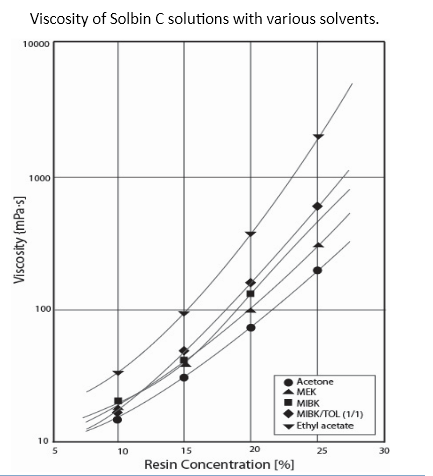
| Solution Viscosity (mPa*s)(MIBK/TOL. 20% @ 25°C) | 150 ± 30 |
Applications:
- Metal Protective Paints—Excellent non-corrosive properties.
- Metal Container Paints –Its anti-corrosive properties makes it an excellent choice for lining food and beverage containers, including applications for medicines and cosmetics. It produces a tough film that makes it ideal for coating steel and galvanized tin plates that will be fabricated later.
- Paper and Textile Coating-Provides a waterproof protection, adding gloss for a better decorative effect.
- Ship Paints— Exceptionally high anticorrosive properties make it ideal for topcoat as well as wash primer and second coat applications.
- Cellophane coating—SOLBIN C is damp-proof making its film readily heat sealed ideal for coating cellophane.
- Concrete and Plaster Paints— Coating the walls of quays.
- Adhesives—PVC and Blister packages.
- Plastic coatings—Adds gloss to both coating and printing on plastic.
How to Use:
- To ensure Solbin C quickly goes into solution it is recommended to disperse it into a weaker solvent such as toluene and xylene then blend with the stronger solvent.
- Solbin C is usually dissolved in a combination of both ketone (e.g. MEK and MIBK) and aromatic hydrocarbon (e.g. toluene and xylene) solvents in equal proportions, to produce a solution of 15%-20% concentration by weight. For coatings on a porous substance, (paper or cloth), faster drying solvents such as MEK and acetone are recommended.
- For Spray coating, MIBK is used. For baking on metals, ketone with a high boiling point such cyclohexanone is used. For roll coatings, cyclohexanone or isophorone are sometimes used. Heating to around 50°C and sufficient agitation are required to speed up dissolving.
- In order to provide proper flexibility, resilience and adhesiveness to film, 5-20 PHR of plasticizer are added. The kind and amount of plasticizer to be added can be determined in the same manner as in the method of blending polyvinyl chloride resins.
- Most common pigments can be employed.
- Stabilizers against heat and light are used, as with conventional polyvinyl chloride resins. The addition of about 0.2% propylene oxide, in this case, can prevent the corrosion of containers and change in paints in storage.
- Any method of coating, including spraying, roll coating and others, may be used. For roll coating, a solution of 200-400 seconds in Ford Cup No.4 viscosity should be used. For Spray applications a solution of 60-80 seconds Ford Cup No.4 viscosity should be used at an air pressure of 98-100psi and a liquid pressure of 20-30psi.
- Solbin C does not usually provide satisfactory adhesion through air drying alone. The following chart provides the degree of adhesion to various surfaces by air drying:
- Short-time baking at 170-190°C will significantly improve ad- hesion and surface gloss. When primers are used, sufficient adhesion may be obtained without baking.
Solubility
| Solvent | 25°C | 50°C | Solvent | 25°C | 50°C |
| Tetrahydrofuran | S | S | Methanol | I | I |
| Acetone | S | S | Isopropanol | I | I |
| MEK | S | S | n-Butanol | I | I |
| MIBK | S | S | Ethylene glycol | I | I |
| Cyclohexanone | S | S | Methyl acetate | I | SC |
| Ethylene dichloride | S | S | Ethyl acetate | I | S |
| Aromatic | SW | SW | Butyl acetate | I | S |
| Toluene | SW | SW | DBP | S | S |
| Xylene | SW | SW | Dioxane | S | S |
| Aliphatic Hydrocarbon | I | I | Isophorone | S | S |
| Notes: S...Soluble; SC...Soluble but turns cloudy; SW...Swells; I...Insoluble | |||||
Compatibility With Modifying Resins
| Compatability with Modifying Resins | SOLBIN C / Other | |||||
|---|---|---|---|---|---|---|
| 9/1 | 4/1 | 1/1 | 1/4 | |||
| Alkyd | Beckosol*1 | 1307-60-EL | O | O | O | X |
| 1334-EL | O | O | X | X | ||
| 1323-60-EL | O | O | X | X | ||
| Styrene-Alkyd | Styresol*1 | 4250 | Δ | Δ | X | X |
| 4400 | Δ | X | X | X | ||
| Melamine | Beckamine *1 | J-138 | Δ | X | X | X |
| Superbeckamine *1 | TD-126 | O | O | Δ | X | |
| J-820 | Δ | Δ | X | X | ||
| G-821 | O | O | Δ | X | ||
| Epoxy | Epikote*2 | 828 | O | O | O | O |
| 1001 | O | O | X | X | ||
| Urethane | Nippolan*3 | 2300 series | O | O | O | O |
| 3000 series | O | O | O | O | ||
| Coronate*3 | L | O | O | O | ||
SOLBIN C:
Coating/film Notes:
Ο – Transparent ; ∆ – Slightly clouded;
X – Whitish or knurled. *1 — DIC Crop.; *2 — Japan Epoxy
Resins Co. Ltd.; *3 Nippon Polyurethane Industry Co., Ltd.
Please contact:
Shin-Etsu MicroSi
Phone: 1.888.642.7674
Website: www.microsi.com
Nissin Chemical Industry Co., Ltd.
Phone: +81.3.3295.3931
Website: www.nissin-chem.co.jp
Rating Table
| Excellent | Polyvinyl chloride resin, Acryl resin |
| Good | Concrete, Plaster |
| Fair | Chlorinated rubber |
| Inferior | Metal, Wood, Paper, Cloth, Phenol resin, Alkyd resin, Butyral resin, Celluloid, Shellac, Dried waterborne or oil paints |
- CAUTION !
- Follow the precautions in the material safety data sheet and technical references.
- SOLBIN is for industrial use only.
- The data in the this document does not include all specifications. Purchasers must conduct tests of their own before putting the product to practical use to verify its compliance, with their intentions for its employment. We give no guarantee that the uses presented in this document do not come in conflict with any patents. For the purpose of enhancement of performance or change of specifications, the contents in this document are subject to revision without notice.
- Permission is required to reprint our data.
Solbin Printing Ink
| Grade | Composition (VC) | Composition (Vac) | Composition (Other) (Wt%) | Degree of polymerization | Average molecular Mn (×10⁴) | Glass-transition temperature (Celsius) | Solid Content (%) (mPa.s/25℃) | K-value | Features |
|---|---|---|---|---|---|---|---|---|---|
| A | Composition (VC)92 | Composition (Vac)3 | Composition (Other) (Wt%)5 Vinyl Alcohol | Degree of polymerization420 | Average molecular Mn (×10⁴)3.5 | Glass-transition temperature (Celsius)76 | Solid Content (%) (mPa.s/25℃)220 | K-value48 | Features |
| AL | Composition (VC)93 | Composition (Vac)2 | Composition (Other) (Wt%)5 Vinyl alcohol | Degree of polymerization300 | Average molecular Mn (×10⁴)2.7 | Glass-transition temperature (Celsius)76 | Solid Content (%) (mPa.s/25℃)70 | K-value42 | FeaturesLess viscous than grade A |
| C | Composition (VC)87 | Composition (Vac)13 | Composition (Other) (Wt%) | Degree of polymerization420 | Average molecular Mn (×10⁴)3.6 | Glass-transition temperature (Celsius)70 | Solid Content (%) (mPa.s/25℃)150 | K-value48 | FeaturesGas-tight and highly resistant to waterHighly resistant to chemicals. Highly transparent |
| C5R | Composition (VC)79 | Composition (Vac)21 | Composition (Other) (Wt%) | Degree of polymerization350 | Average molecular Mn (×10⁴)2.6 | Glass-transition temperature (Celsius)68 | Solid Content (%) (mPa.s/25℃)60 | K-value45 | Features |
| CH | Composition (VC)86 | Composition (Vac)14 | Composition (Other) (Wt%) | Degree of polymerization650 | Average molecular Mn (×10⁴)5 | Glass-transition temperature (Celsius)73 | Solid Content (%) (mPa.s/25℃)700 | K-value57 | FeaturesMore viscous than Grade C Highly transparent and resistant to heat and weather |
| CL | Composition (VC)86 | Composition (Vac)14 | Composition (Other) (Wt%) | Degree of polymerization300 | Average molecular Mn (×10⁴)2.5 | Glass-transition temperature (Celsius)70 | Solid Content (%) (mPa.s/25℃)60 | K-value42 | FeaturesLess viscous than grade C Highly soluble Highly transparent |
| CN | Composition (VC)89 | Composition (Vac)11 | Composition (Other) (Wt%) | Degree of polymerization750 | Average molecular Mn (×10⁴)4.2 | Glass-transition temperature (Celsius)75 | Solid Content (%) (mPa.s/25℃)40*1 | K-value60 | FeaturesHigh viscosity, forms strong coating film Highly transparent |
| CNL | Composition (VC)90 | Composition (Vac)10 | Composition (Other) (Wt%) | Degree of polymerization200 | Average molecular Mn (×10⁴)1.2 | Glass-transition temperature (Celsius)76 | Solid Content (%) (mPa.s/25℃)30 | K-value33 | FeaturesLess viscous than grade CN, highly soluble Highly transparent |
| M5 | Composition (VC)85 | Composition (Vac)14 | Composition (Other) (Wt%)1 Dicarboxylic acid | Degree of polymerization430 | Average molecular Mn (×10⁴)3.3 | Glass-transition temperature (Celsius)69 | Solid Content (%) (mPa.s/25℃)130 | K-value49 | FeaturesStrongly adheres to metals, aluminum, and cellophane |
| TA3 | Composition (VC)83 | Composition (Vac)4 | Composition (Other) (Wt%)13 Hydroxyalkyl ac rylate | Degree of polymerization350 | Average molecular Mn (×10⁴)3.2 | Glass-transition temperature (Celsius)65 | Solid Content (%) (mPa.s/25℃)80 | K-value45 | FeaturesFavorably disperses pigments and magnetic powdersMore thermostable than Grade A, less viscous |
Note: The values in the table are representative values, not standard values.
Solbin Coating Paint
| Grade | Composition (VC) | Composition (Vac) | Composition (Other) (Wt%) | Degree of polymerization | Average molecular Mn (×10⁴) | Glass-transition temperature (℃) | Solid Content (%) (mPa.s/25℃) | K-value | Features |
|---|---|---|---|---|---|---|---|---|---|
| A | Composition (VC)92 | Composition (Vac)3 | Composition (Other) (Wt%)5 Vinyl Alcohol | Degree of polymerization420 | Average molecular Mn (×10⁴)3.5 | Glass-transition temperature (℃)76 | Solid Content (%) (mPa.s/25℃)220 | K-value48 | Features |
| AL | Composition (VC)93 | Composition (Vac)2 | Composition (Other) (Wt%)5 Vinyl Alcohol | Degree of polymerization300 | Average molecular Mn (×10⁴)2.7 | Glass-transition temperature (℃)76 | Solid Content (%) (mPa.s/25℃)70 | K-value42 | FeaturesLess viscous than grade A |
| C | Composition (VC)87 | Composition (Vac)13 | Composition (Other) (Wt%) | Degree of polymerization420 | Average molecular Mn (×10⁴)3.6 | Glass-transition temperature (℃)70 | Solid Content (%) (mPa.s/25℃)150 | K-value48 | FeaturesGas-tight and highly resistant to water. Highly resistant to chemicals. Highly transparent. |
| C5R | Composition (VC)79 | Composition (Vac)21 | Composition (Other) (Wt%) | Degree of polymerization350 | Average molecular Mn (×10⁴)2.6 | Glass-transition temperature (℃)68 | Solid Content (%) (mPa.s/25℃)60 | K-value45 | Features |
| CH | Composition (VC)86 | Composition (Vac)14 | Composition (Other) (Wt%) | Degree of polymerization650 | Average molecular Mn (×10⁴)5 | Glass-transition temperature (℃)73 | Solid Content (%) (mPa.s/25℃)700 | K-value57 | FeaturesMore viscous than Grade C. Highly transparent and resistant to heat and weather. |
| CL | Composition (VC)86 | Composition (Vac)14 | Composition (Other) (Wt%) | Degree of polymerization300 | Average molecular Mn (×10⁴)2.5 | Glass-transition temperature (℃)70 | Solid Content (%) (mPa.s/25℃)60 | K-value42 | FeaturesLess viscous than grade C. Highly soluble. Highly transparent. |
| CN | Composition (VC)89 | Composition (Vac)11 | Composition (Other) (Wt%) | Degree of polymerization750 | Average molecular Mn (×10⁴)4.2 | Glass-transition temperature (℃)75 | Solid Content (%) (mPa.s/25℃)40*1 | K-value60 | FeaturesHigh viscosity, forms strong coating file. Highly transparent. |
| M5 | Composition (VC)85 | Composition (Vac)14 | Composition (Other) (Wt%)1 Dicarboxylic acid | Degree of polymerization430 | Average molecular Mn (×10⁴)3.3 | Glass-transition temperature (℃)69 | Solid Content (%) (mPa.s/25℃)130 | K-value49 | FeaturesStrongly adheres to metals, aluminum, and cellophane |
| TA3 | Composition (VC)83 | Composition (Vac)4 | Composition (Other) (Wt%)13 Hydroxyalkyl acrylate | Degree of polymerization350 | Average molecular Mn (×10⁴)3.2 | Glass-transition temperature (℃)65 | Solid Content (%) (mPa.s/25℃)80 | K-value45 | FeaturesFavorably disperses pigments and magnetic powders. More thermostable than Grade A, less viscous |
Note: The values in the table are representative values, not standard values.
Solbin Adhesive
| Grade | Composition (VC) | Composition (Vac) | Composition (Other) (Wt%) | Degree of polymerization | Average molecular Mn (×104) | Glass-transition temperature (℃) | Solid Content (%) (mPa.s/25℃) | K-value | Features |
|---|---|---|---|---|---|---|---|---|---|
| A | Composition (VC)92 | Composition (Vac)3 | Composition (Other) (Wt%)5 Vinyl alcohol | Degree of polymerization420 | Average molecular Mn (×104)3.5 | Glass-transition temperature (℃)76 | Solid Content (%) (mPa.s/25℃)220 | K-value48 | Features |
| AL | Composition (VC)93 | Composition (Vac)2 | Composition (Other) (Wt%)5 Vinyl alcohol | Degree of polymerization300 | Average molecular Mn (×104)2.7 | Glass-transition temperature (℃)76 | Solid Content (%) (mPa.s/25℃)70 | K-value42 | FeaturesLess viscous than grade A |
| C | Composition (VC)87 | Composition (Vac)13 | Composition (Other) (Wt%) | Degree of polymerization420 | Average molecular Mn (×104)3.6 | Glass-transition temperature (℃)70 | Solid Content (%) (mPa.s/25℃)150 | K-value48 | FeaturesGas-tight and highly resistant to chemicals. Highly transparent |
| C5R | Composition (VC)79 | Composition (Vac)21 | Composition (Other) (Wt%) | Degree of polymerization350 | Average molecular Mn (×104)2.6 | Glass-transition temperature (℃)68 | Solid Content (%) (mPa.s/25℃)60 | K-value45 | Features |
| CH | Composition (VC)86 | Composition (Vac)14 | Composition (Other) (Wt%) | Degree of polymerization650 | Average molecular Mn (×104)5 | Glass-transition temperature (℃)73 | Solid Content (%) (mPa.s/25℃)700 | K-value57 | FeaturesMore viscous than Grade C. Highly transparent and resistant to heat and weather. |
| CL | Composition (VC)86 | Composition (Vac)14 | Composition (Other) (Wt%) | Degree of polymerization300 | Average molecular Mn (×104)2.5 | Glass-transition temperature (℃)70 | Solid Content (%) (mPa.s/25℃)60 | K-value42 | FeaturesLess viscous than grade C. Highly soluble. Highly transparent. |
| CN | Composition (VC)89 | Composition (Vac)11 | Composition (Other) (Wt%) | Degree of polymerization750 | Average molecular Mn (×104)4.2 | Glass-transition temperature (℃)75 | Solid Content (%) (mPa.s/25℃)40*1 | K-value60 | FeaturesHigh viscosity, forms strong coating film. Highly transparent. |
| M5 | Composition (VC)85 | Composition (Vac)14 | Composition (Other) (Wt%)1 Dicarboxylic acid | Degree of polymerization430 | Average molecular Mn (×104)3.3 | Glass-transition temperature (℃)69 | Solid Content (%) (mPa.s/25℃)130 | K-value49 | FeaturesStrongly adheres to metals, aluminum, and cellophane |
| TA3 | Composition (VC)83 | Composition (Vac)4 | Composition (Other) (Wt%)13 Hydroxyalkyl acrylate | Degree of polymerization350 | Average molecular Mn (×104)3.2 | Glass-transition temperature (℃)65 | Solid Content (%) (mPa.s/25℃)80 | K-value45 | FeaturesFavorably disperses pigments and magnetic powders. More thermostable than Grade A, less viscous. |
Note: The values in the table are representative values, not standard values.